Baby Milestones by Month: A Guide That Fits Your Baby
By:Author:Welcome Baby Editorial
Updated on:October 20, 2026

- The Myth That a Monthly Chart Is a Deadline
- How Baby Milestones by Month Actually Unfold
- What Changes the Pace of Baby Milestones
- A Sample Month-By-Month Routine Worth Copying
- Fitting Monthly Milestone Watching Into Busy Weeks
- Setting Expectations for the Months Between Skills
- Common Mistakes When Tracking Monthly Milestones
- Recording Baby Milestones by Month With Welcome Baby
- Keeping Monthly Milestones in Perspective
Baby milestones by month follow a rough order - head control, then rolling, then sitting, then crawling, then walking - but the exact month each one lands varies a lot from baby to baby.
That spread exists because development isn't a straight line. Each new skill builds on muscle control, balance and motivation that stack up gradually, so a baby who's focused on one skill often takes longer to hit the next.
This guide walks through what tends to happen month by month, what actually shifts the timing, a simple way to build it into daily routines, and the mistakes that cause unnecessary worry.
The Myth That a Monthly Chart Is a Deadline
No, a baby milestones by month chart is not a deadline, and a baby who hits something a few weeks later than a chart suggests isn't behind.
Charts describe an average range built from thousands of different babies, which means half the babies counted hit each skill later than the midpoint shown and still ended up fine.
The real answer is to treat monthly charts as a rough map of order and general timing, not a countdown. What matters more is the direction - is the baby generally gaining new skills over time, even if the exact month doesn't match a chart.
How Baby Milestones by Month Actually Unfold
Two things drive the month-by-month pattern: physical readiness and repeated practice. Neither one works without the other.
Physical Readiness Builds From the Top Down
Babies gain control of their neck and shoulders before their trunk, and their trunk before their legs, which is why head control tends to show up before sitting and sitting before standing.
Repetition Turns a Wobbly Attempt Into a Reliable Skill
A baby might manage a skill once by accident weeks before they can do it on demand, because the muscles and balance need repeated practice to become dependable.
Put together, this means the order of milestones is fairly consistent across babies, even though the exact month each one appears is not.
What Changes the Pace of Baby Milestones
A few factors tend to move the timing of monthly milestones more than anything else.
Factors That Shift the Timing
- Amount of practice time - a baby who gets regular floor time or supported sitting practice each day tends to build the related muscles sooner than one who spends most of the day in a seat or carrier.
- Body size and build - a larger or smaller baby can find certain movements easier or harder simply because of the mechanics involved, which can nudge timing earlier or later.
- Which skill a baby is focused on - a baby concentrating on babbling or grasping may put less energy into gross motor skills for a while, which can shift when the next physical milestone shows up.
A Sample Month-By-Month Routine Worth Copying
There's no single routine that fits every baby, but a simple weekly rhythm can support whatever stage a baby is in right now.
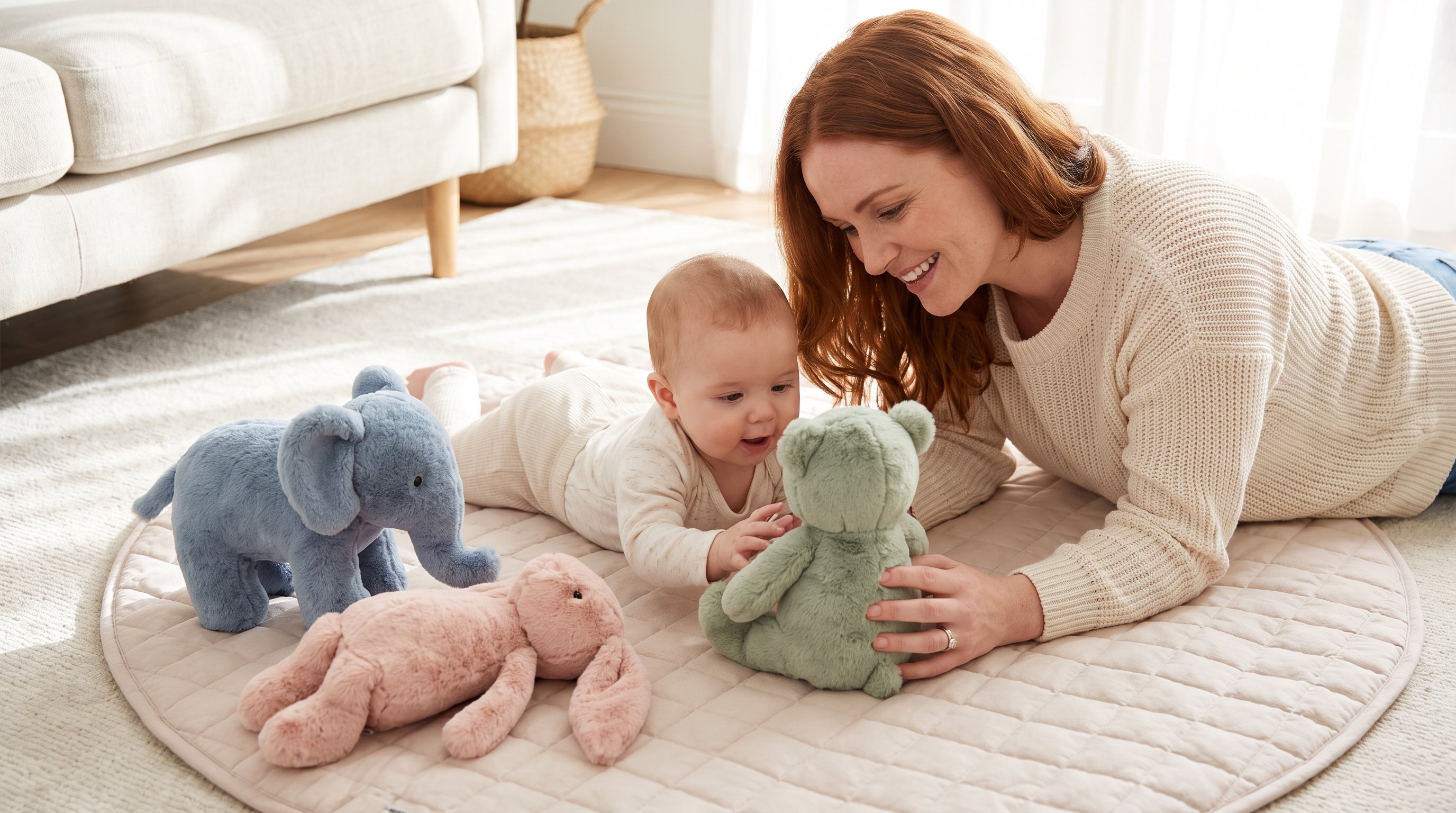
A Week Built Around the Current Stage
- Morning floor time - a stretch of unhurried time on a mat gives a baby room to practise whatever movement they're working on, whether that's rolling, reaching or pushing up.
- Supported practice after a nap - once a baby is alert, a few minutes of supported sitting, standing or assisted steps gives the relevant muscles a short, low-pressure workout.
- Quiet narration during routine care - talking through nappy changes, feeds and baths gives language skills steady exposure without needing a separate activity slot.
- An evening wind-down with a book or song - a calm close to the day supports listening and attention, which feeds into later language and social milestones.
Fitting Monthly Milestone Watching Into Busy Weeks
Most families don't have spare hours to dedicate to milestone practice, and they don't need to.
Folding movement and talk into nappy changes, mealtimes and the walk to the car covers most of what a baby needs, since the muscles and skills develop through ordinary repeated contact, not special sessions.
Jotting down what a baby is doing each month, even briefly, helps a tired parent see progress that's easy to miss day to day - which is the gap Welcome Baby's guided memory pages are built to fill, giving each month a place to land instead of relying on memory alone.
Setting Expectations for the Months Between Skills
The gap between one milestone and the next can stretch longer than expected, and that stretch is normal rather than a sign something is off.
Some babies move through several skills close together and then pause for weeks before the next one appears, often because their energy is going into something less visible, like coordination or balance that isn't obvious yet.
Rather than counting weeks against a chart, it helps to watch for the general trend - new attempts, new interest, new strength - over the course of a month rather than expecting steady weekly change.
Common Mistakes When Tracking Monthly Milestones
Comparing One Baby Directly to Another
Two babies the same age can be months apart on a given skill and both be entirely typical, so comparing them head to head usually just creates worry without any real benefit.
Treating Every Chart Month As a Hard Cutoff
Charts give a range, not a cutoff, so it helps to look at the whole range for a skill rather than fixating on the earliest month listed.

Only Checking in Once a Milestone Feels Overdue
Waiting until worry sets in to look back at what a baby has been doing makes it harder to spot the small, steady gains that happened along the way - a running note each month avoids that gap.
Skipping Notes During the Hard Weeks
The weeks that feel the most chaotic are often the ones with the most change happening, so skipping notes then is exactly when the most gets missed.
Recording Baby Milestones by Month With Welcome Baby
Keeping track of baby milestones by month doesn't need to turn into another chore on an already long list.
Welcome Baby gives each stage its own guided page, so a quick note about a new movement, sound or expression has somewhere to go the moment it happens, rather than getting lost between naps and feeds. The structure follows a baby's own pace rather than forcing entries into a rigid monthly template, and it's built to be filled in gradually, becoming a fuller record the longer it's kept.

Prepare For Your Baby
Your Baby Plan
Keeping Monthly Milestones in Perspective
The most useful habit with baby milestones by month is a light one: notice what's new, jot it down, and move on with the week.
Pick one small thing to record this week - a new sound, a new reach, a new attempt at sitting - and give it a place to live, whether that's a quick note on a phone or a page in Welcome Baby set aside for exactly that purpose.
FAQ
A short, consistent note each month beats a long detailed entry done occasionally, since consistency is what actually builds a usable record over time. Welcome Baby's guided pages give that habit a fixed spot so it's easier to keep up.
Not reliably - a baby who rolls or sits early isn't guaranteed to walk or talk early too, since each skill depends on its own mix of muscle development and practice. Milestones in one area don't predict the pace of milestones in another.
Most babies sit somewhere other than the exact midpoint of a chart range, and that alone isn't a reason for concern. Watching for general forward progress over weeks tends to be more useful than measuring against a single chart month.
Regular floor time, supported practice and everyday interaction all give a baby's developing muscles and brain more chances to practise, but none of that works like a shortcut or guarantees an earlier date. The timing still comes down to the individual baby.
Share this post